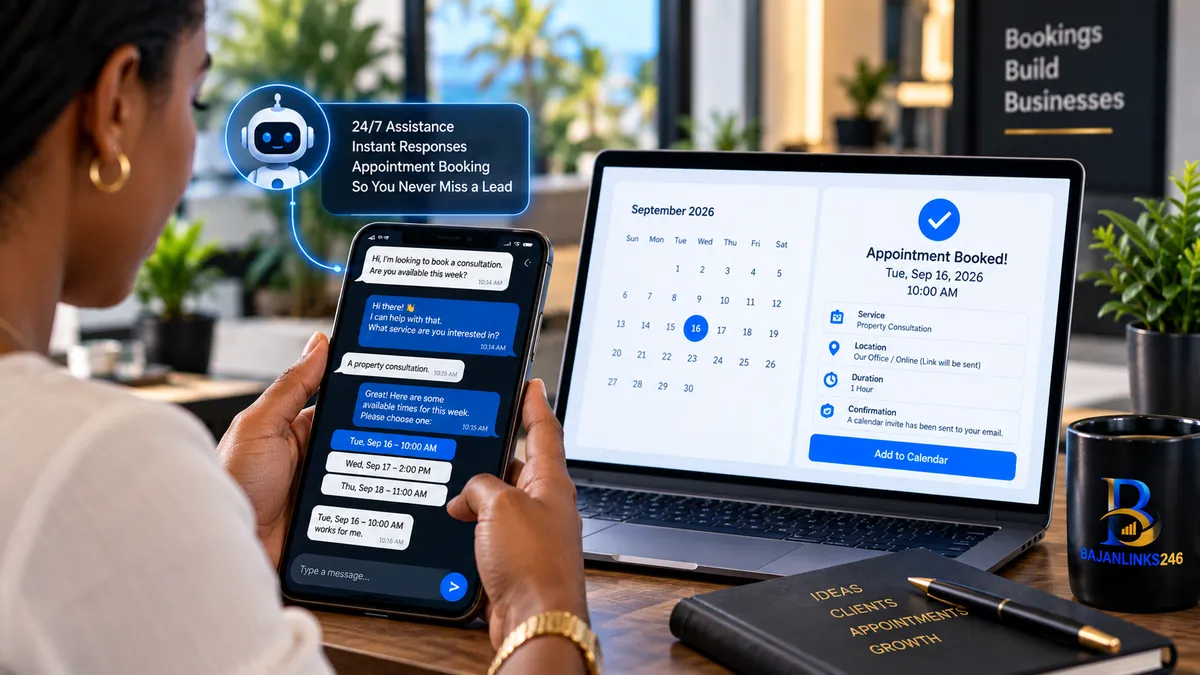
How AI Appointment Booking Works for Service Businesses
How AI Appointment Booking Works for Service Businesses
A potential customer doesn't care that you're in a meeting, driving to a job, serving another client or finally getting some sleep.
When they're ready to contact a business, they're ready now.
For service businesses, that creates a problem.
You can't personally be available every minute of every day.
Your system can.
WHAT IS AI APPOINTMENT BOOKING?
AI appointment booking combines customer communication with automation and your scheduling process.
Instead of simply displaying a calendar, the system can help determine what the customer needs before moving them toward the appropriate next step.
Depending on the business and configuration, that can include answering common questions, collecting contact information, identifying the requested service, qualifying the enquiry and directing the prospect toward available appointments.
Once an appointment is booked, the system can trigger confirmation and reminder workflows.
WHY IS THIS DIFFERENT FROM A NORMAL BOOKING CALENDAR?
A normal booking calendar handles scheduling.
That's useful.
But the customer journey usually starts before the calendar.
Someone may have a question first.
They may not know which service they need.
They may complete a website form instead of clicking your calendar.
They may contact the business outside normal operating hours.
A connected booking system handles more of that journey.
The calendar becomes one component inside the larger customer acquisition process.
RESPONDING WHILE INTEREST IS HIGH
Timing matters when someone is actively looking for a service.
If an enquiry sits unanswered for several hours, the prospect has plenty of time to continue searching.
Automated response gives businesses a way to acknowledge and begin handling enquiries quickly, including when staff aren't immediately available.
This doesn't mean every conversation should be handed entirely to AI.
Human involvement still matters when a situation requires judgment, expertise or a personal conversation.
The goal is to prevent routine enquiries from sitting untouched.
QUALIFY BEFORE BOOKING
Not every enquiry should automatically become an appointment.
Depending on the business, you may need to know the service required, location, budget, urgency or other basic information first.
An intelligent intake process can collect those details before directing the prospect toward the correct calendar or next step.
This helps businesses avoid filling their calendars with appointments that were never a good fit.
AUTOMATED CONFIRMATIONS AND REMINDERS
Getting an appointment onto the calendar is only part of the job.
Customers forget.
Schedules change.
People lose confirmation emails.
Automated confirmation and reminder workflows help maintain communication after the booking.
They can also make rescheduling easier when configured correctly.
AI SHOULD SUPPORT YOUR TEAM, NOT CREATE MORE WORK
The purpose of booking automation isn't to add another complicated tool your staff has to manage.
The technology should simplify the process.
Website enquiries, customer information, CRM records, follow-up and calendar bookings should work together as much as possible.
That's where businesses begin seeing the operational value of automation.
BUILD A CUSTOMER JOURNEY THAT DOESN'T DEPEND ON YOU BEING ONLINE
If your business relies on appointments, consultations, quotations or calls, your ability to respond shouldn't disappear every time you're busy.
A connected booking system gives prospects a way to continue moving forward.
The BajanLinks246 Booking System combines a conversion-focused website, lead capture, customer response, CRM, automated follow-up and appointment booking into one connected customer journey.
See the system in action and book a call to discuss how it could work for your business.